

What are the most common pitfalls of buying property in Spain? And, how can foreign buyers protect their investment? The Costa del Sol property market continues to attract thousands of foreign buyers each year. Whilst the dream of owning a Spanish villa or apartment is appealing, many expatriates encounter serious legal complications that could have been avoided with proper guidance.
1. Understanding the Spanish property purchasing system
The Spanish conveyancing process differs significantly from that of the UK and other European countries. One of the most critical differences is the absence of a solicitor acting as an intermediary between parties. Instead, a notary merely formalises the agreement without necessarily protecting the buyer’s interests.
For this reason, it is highly advisable, although not legally mandatory, to seek the advice and guidance of an independent lawyer who specialises in Spanish real estate law, in order to avoid the common pitfalls of buying property in Spain. A qualified professional in this field can act as a crucial safeguard throughout the entire purchasing process, ensuring that the client’s interests are fully protected at every stage.
Their role goes far beyond formal review; they are able to carry out a thorough legal due diligence, identify potential risks, and anticipate any of the common pitfalls of buying property in Spain before the buyer becomes exposed to them. In a market where procedures, documentation requirements, and legal frameworks can vary significantly from those in other jurisdictions, having expert legal support provides not only clarity and confidence, but also a much-needed layer of security in what is often one of the most significant financial decisions a person will make.
2. The role of the Spanish Notary: A common misconception
One of the most dangerous myths for foreign buyers is believing that the Notary is “their” lawyer. In the Spanish legal system, the Notary is a public official who acts as a neutral witness to the transaction. Their primary duty is to ensure the document complies with the law and to verify the identities of the parties involved.
However, a Notary does not represent you. And the Notary’s intervention will not help you to avoid the common pitfalls of buying property in Spain.
Here is why they won’t necessarily protect your specific interests:
- Neutrality vs. Advocacy: The Notary remains impartial. They will not tell you if the price is too high, if the contract terms are skewed in favor of the seller, or if there is a “better” way to structure the taxes.
- Limited Investigation: While they check the Nota Simple at the moment of signing, they do not conduct the deep-dive “detective work” required. They won’t visit the Town Hall to check for future urban planning projects or verify if the pool was built with a hidden illegal license.
- Formalization, not Negotiation: The Notary formalizes what has already been agreed upon. If you sign a private contract (Arras) without legal advice, by the time you reach the Notary, it is often too late to change the terms.
- The clue is: Think of the Notary as the referee of a match; they make sure the rules are followed, but they aren’t there to help your team win. That is what your independent lawyer is for.
3. Common pitfalls to avoid (and how to do it) when buying property in Spain
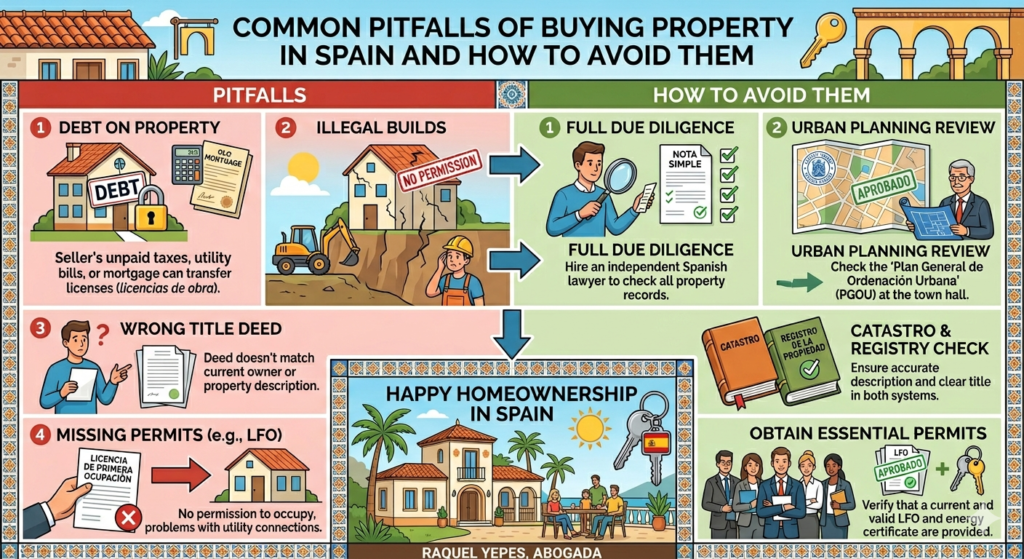
1. Undisclosed debts attached to the property
Properties in Spain may come with outstanding community fees, utility bills, or even mortgage debts that automatically transfer to the new owner upon purchase. According to the Spanish Land Registry, approximately 17% of foreign property purchases involve some form of undisclosed debt.
2. Illegal constructions and planning issues
Many properties, particularly in coastal areas, may have been built without proper permissions or with additions that violate local regulations. These can result in substantial fines or even demolition orders.
3. Incorrect property boundaries
The cadastral description (official property record) may not accurately reflect the actual boundaries of the property, leading to disputes with neighbours or authorities.
Navigating these common pitfalls is much easier when you have a solid strategy in place. While understanding the risks is the first step, the most effective way to protect your investment is through a comprehensive legal review.
For a detailed breakdown of the essential steps you should take before signing any contracts, be sure to read our dedicated guide on Property Due Diligence in Spain.
4. Real-life scenarios buyers may encounter: Common pitfalls of buying property in Spain
The reality of the Spanish property market can be complex for those unfamiliar with local regulations. Here are a few common scenarios where professional legal oversight makes the difference between a dream home and a financial headache:
- The “Urban” Trap: Imagine finding a charming villa in the Axarquía or the outskirts of Marbella, only to discover after the purchase that it was built on suelo no urbanizable (rural land) without the proper licenses. Without a thorough check of the DAFO status or the PGOU, you could face hefty fines or even demolition orders.
- The Inherited Debt: You fall in love with an apartment in Málaga’s Soho. The seller seems trustworthy, but what they haven’t mentioned are the thousands of euros in unpaid IBI (property tax) and community fees from the last three years. In Spain, these debts follow the property, meaning the new owner becomes responsible for them if not cleared before the sale.
- The Disappearing “Arras”: A buyer pays a significant deposit (arras) directly to a seller to “reserve” a house, only to find out later that the property has multiple owners who don’t agree on the sale. Without a properly drafted contract by an independent lawyer, recovering that money can turn into a years-long legal battle.
These aren’t just cautionary tales; they are the reasons why I insist on a rigorous due diligence process.
Protecting your rights means anticipating these scenarios before they ever reach the notary’s office.
5. Frequently asked questions about common pitfalls of buying property in Spain
Do I need a Spanish lawyer to buy property safely?
While not legally required, engaging a specialist property lawyer who represents only your interests is strongly recommended. Your lawyer should conduct thorough due diligence, checking for debts, planning permissions, and ensuring all documentation is properly registered.
What checks should be done before signing a purchase contract?
Essential checks include verifying the seller’s true ownership, confirming there are no debts or charges on the property, checking planning status with the local town hall, and ensuring the property description matches reality.
How can I protect my deposit when buying Spanish property?
Always ensure your deposit is held in a segregated client account, and that contracts include clear conditions for its return should legal issues be discovered during the due diligence process.
6. Avoiding common pitfalls of buying property in Spain: Your peace of mind is my priority
Investing in Spain should be an exciting milestone, not a source of legal anxiety. The sun, the lifestyle, and the opportunities in Málaga are waiting for you, but the journey requires a steady hand to guide you through the local bureaucracy.
By conducting rigorous due diligence and anticipating potential pitfalls, I ensure that your only concern is where to place the furniture in your new Mediterranean home. Whether you are buying from the USA, the UK, the European Union or anywhere else in the world, my mission is to provide you with the legal certainty you deserve.
Ready to secure your investment? Don’t leave your rights to chance. Contact me today for a consultation tailored to your international needs, far from the pressure from agents or sellers.


