

When reviewing a Spanish land registry report (nota simple), foreign buyers often encounter a reference to a “fiscal charge” or “afección fiscal”. This concept is frequently misunderstood and may generate unnecessary concern about hidden debts attached to the property.
This article provides a technical legal explanation of what the Spanish land registry tax charge (afección fiscal) actually means, its legal basis, duration, and whether it represents a real risk for property purchasers in Spain.
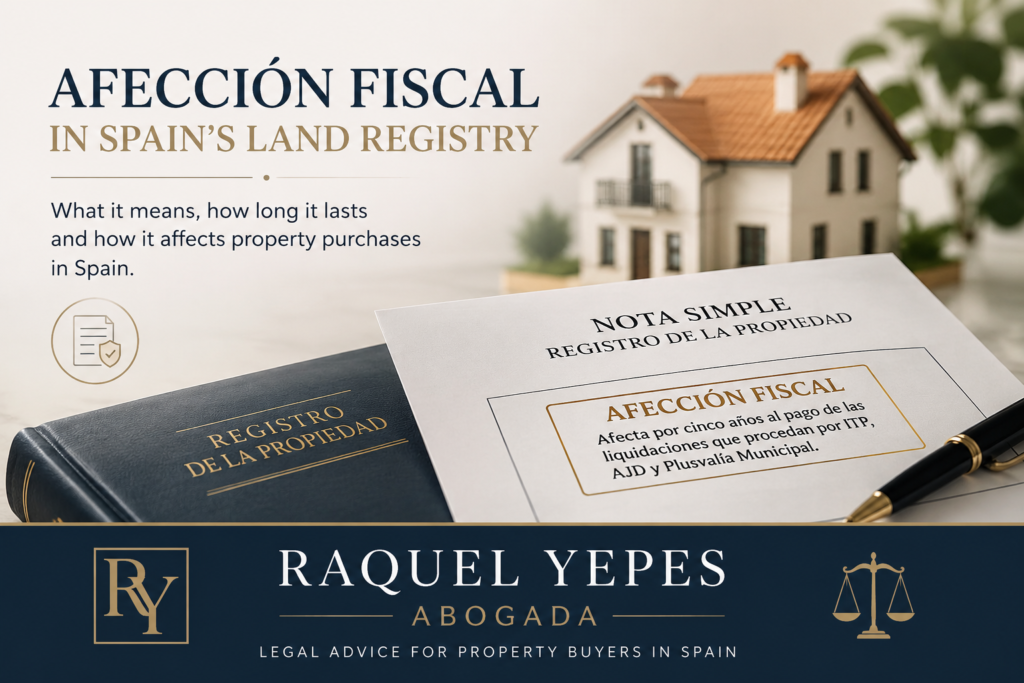
1. What is the “Afección Fiscal” (Spanish Land Registry Tax Charge)?
The afección fiscal is a statutory guarantee in favor of the Spanish Tax Authorities recorded in the Land Registry. It indicates that a property is subject to a potential liability for certain taxes arising from its transfer or acquisition.
It does not mean that there is an outstanding debt attached to the property.
Instead, it reflects a legal principle under Spanish tax law whereby the property itself is temporarily “linked” to the payment of specific taxes, mainly:
- Property Transfer Tax (Impuesto sobre Transmisiones Patrimoniales “ITP“)
- Stamp Duty (Actos Jurídicos Documentados “AJD”)
- Municipal Capital Gains Tax (“Plusvalía Municipal”, also called “IIVTNU”)
2. Legal Nature of the Spanish Land Registry Tax Charge
From a legal perspective, the afección fiscal is:
- A real guarantee mechanism, not a substantive encumbrance
- A statutory liability attached to the asset, not to the owner personally
- A temporary safeguard for the Tax Administration
Its purpose is to ensure that, in case the taxpayer fails to pay the corresponding tax, the Administration may enforce collection against the property within a limited period.
Importantly, this does not affect the ownership or the free transferability of the property.
3. Duration of the Spanish Land Registry Tax Charge
The tax charge is not indefinite. Its duration is strictly limited by the statute of limitations applicable to the relevant taxes.
In general terms, they may be cancelled due to expiry after five years from their date.Once this period expires, the Tax Authority’s right to enforce the tax liability is extinguished.
After expiration, the afección fiscal should no longer have legal effect, even if still visible in registry records. However, in practice, outdated references may sometimes remain in registry entries until formally cancelled.
4. Does the Spanish Land Registry Tax Charge Affect Property Purchases?
For buyers, especially foreign investors, the key question is whether this annotation represents a real risk.
The legal answer is generally no.
The afección fiscal:
- Does not prevent the sale of the property
- Does not imply the existence of a debt
- Does not transfer tax liability to the buyer beyond statutory limits
However, it has practical relevance in due diligence because:
- It signals that taxes associated with a prior transaction must have been properly assessed and paid
- It confirms the period during which the Tax Authority could theoretically claim against the property
5. Risk Scenarios Buyers Should Be Aware Of, concerning the Spanish Land Registry Tax Charge
Although in most cases the afección fiscal is harmless, risks may arise in specific situations:
5.1 Recent acquisitions
If the previous purchase occurred within the last four years, there is a theoretical risk that:
- The tax has not been fully paid, or
- The Tax Authority may still be within the assessment period
5.2 Irregular or incomplete tax filings
If prior transactions were not properly declared, enforcement action could still be possible within the limitation period.
5.3 Registry delays or outdated entries
In some cases, the registry may still display the annotation even after the legal effects have expired.
6. Practical Due Diligence for Foreign Buyers
When purchasing property in Spain, particularly in areas with high international demand such as the Costa del Sol, legal due diligence should always include:
- Full review of the nota simple (land registry extract)
- Verification of tax compliance on previous transfers
- Confirmation of limitation periods
- Cross-checking with municipal tax records where relevant
A qualified legal professional can determine whether any afección fiscal entry has legal significance or is purely formal.
In most cases, the afección fiscal does not affect ownership rights or the purchase process. Its importance lies primarily in legal due diligence, and ensuring historical tax compliance whithin the statutory limitation period.
If you are currently dealing with a property purchase, inheritance, or due diligence process in Spain and want to ensure that no hidden fiscal liabilities are attached to the property, do not leave this to chance. A proactive legal review can prevent costly surprises and delays.
If you would like tailored legal guidance or a clear assessment of how the afección fiscal may affect your specific case, feel free to get in touch. I assist international clients in navigating Spanish property law with clarity and confidence, so you can move forward with security.


